12 Tips On Dealing With Someone Who Has Fibromyalgia, Chronic Fatigue or Chronic Pain.

12 Tips On Dealing With Someone Who Has Fibromyalgia, Chronic Fatigue or Chronic Pain

If you know someone who has fibromyalgia, chronic pain, chronic fatigue syndrome or any other invisible illness her are twelve tips on how to deal with them. There as especially if the person you know is a friend or family member. Remember, they never asked for these illnesses. These are life altering illnesses and we need your support.

1. Be sensitive. We are no longer the person we used to be.

2. Validate us.

3. Don’t just assume we can’t do anything. There are many things we can no longer do, but there are still some activities we can do.

4. Honest communication is not an excuse to be rude or negative.

5. Look for thing we can do and get involved with us.

fibro_12tips_suport

6. While there are things we can do, it’s very likely we will do it much more slowly than normal.

7. If you felt pain 24/7 with chronic fatigue and fibro fog at the same time, how would you want to be treated?

8. Pray for us.

9. Understand, we didn’t ask to have fibro or chronic fatigue and we are not hypochondriacs.

10. Don’t be offended if we don’t act on your advice. We may have already tried it or know better than to try it.

11. Losing your good health is a loss we suffer and sometimes we feel like grieving. Give us space to grieve.

12. Don’t forget about us.

Review Of The Article: Fibromyalgia Now Considered As A Lifelong Central Nervous System Disorder

Review Of The Article: Fibromyalgia Now Considered As A Lifelong Central Nervous System Disorder

This article comes from the website WWW.News-Medical.net and it covers research done by Daniel Clauw, M.D., Professor of Anesthesiology, University of Michigan

I do this review with thirty-one years of chronic pain experience. I spent about twenty years with chronic pain and misdiagnosed with Ankylosing Spondylitis. I’ve been correctly diagnosed with fibromyalgia for the last eleven years. I have been to more than fifteen doctors over the years, maybe more. Fibro fog does a number on the old memory.

The article talks about the research that Dr. Clauw has done on fibromyalgia. It is stated in the article that fibromyalgia is the second most common rheumatic disorder, yet he states that is it a central nervous system disorder. That confuses me. A central nervous system seems like it should be treated by a neurologist, whereas a rheumatic illness would be treated by a Rheumatologist.

The majority of the articles deals with the issue of the central nervous system. He also states that it is a life long CNS disorder.

review_cns_article

When I first read this article over a month ago, I wondered about the assertion that it is a life long disorder. My first thought was, “no it isn’t.” Then I was preparing a Blog post about fibromyalgia having more than 70 symptoms. I thought about a few symptoms manifesting while I was a child, but pain was not among those symptoms. Then I talked to my Neuro-psychologist and she said that people may have fibromyalgia waiting for a stress-induced trigger. That stress inducing trigger might be a car wreck, an operation, abuse or suffering some other traumatic life event.

So maybe it is a lifelong condition. But for me, it has not been a life long chronic pain condition.

Because it is a Central Nervous System (CNS) disorder, the pain one feels with fibromyalgia comes from the brain and spinal cord, not the area of pain. If you feel extreme pain in your lower back, hips or thighs, the pain is coming from the CNS not the lower back, hips or thighs.

This article makes three other questionable statements that I take issue with. First, he asserts that opiates are not a good treatment for fibro. I have eleven years of experience and two pain management doctors who would disagree. My pain is helped a great deal by opiates and muscle relaxers.

And then after making that assertion doesn’t go into detail, but glosses over the alternatives to pain management. He does mention gabapentinoids, trycyclics and serotonoin reuptake inhibitors. Those MEDs have not worked for me and I have heard from many fibromites that they do not work for them as well.

The last criticism is that he states that goal improved function. While he is obviously not a patient of fibromyalgia he can say that, but to those of us with fibromyalgia, we want pain, relief first then we can try to work on improved function. Often, managing pain alone improves function.

The biggest contribution the article makes to the issue of fibromyalgia is that is suggests that fibromyalgia is an illness of the CNS. Other than that, most of the information has already been presented by many other researchers.

What do you think about the article? Do you agree or disagree with my review of the article and why?

Troy Wagstaff ©

I am not a health care professional of any type and I assume no liability for the information and opinions presented in this article or Blog post.

Five Fibromyalgia Emotions – Part One

Five Fibromyalgia EmotionsPart One

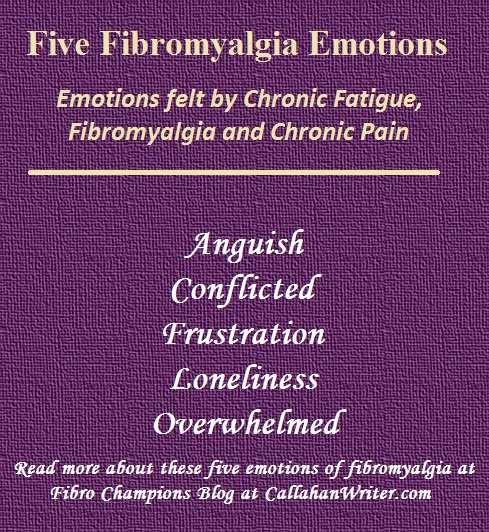
There are countless emotions that those with fibromyalgia, chronic fatigue and chronic pain go through. I will write a small series of posts on some of the emotions that we who are afflicted with one of these chronic invisible illnesses go through. Here are the first five emotions.

Anguish

Anguish is an emotion that is derived from the distress of suffering or from acute suffering. Whether we are in dire life sucking pain or find ourselves drowning in fatigue we are suffering. From that suffering we go through the emotion of dire anguish because there is no end in sight from our suffering.

five_emotions_fibro_part1

Conflicted

Feeling conflicted comes from many different angles when suffering from chronic fatigue or pain. We feel conflicted from the myriad of symptoms that seem to contradict themselves and unless you’ve gone through it, you can scarcely understand that conflicted emotion. We also feel conflicted by the way others treat us. Some are supportive, others unbelieving, and others judgmental.

Frustration

It is so easy to feel frustrated when you are chronically ill, especially with fibromyalgia. You can be having a good day when the pain scale shows your pain at a three or four then out of nowhere are pain jumps up to a nine or ten. The symptoms come and go so much that it is impossible to make firm plans for this evening or next Friday because you don’t know how you will be feeling.

Loneliness

Of all the emotions we go through, loneliness is one of the roughest to experience. Being healthy and lonely is tough, but being chronically sick and in pain all the time adds to your feeling loneliness. Even if you are around supportive family and friends and they are talking about their day or their vacation you feel lonely because you can be a part of that conversation. Who wants to hear about your pain and stiffness or your fatigue or chronic headaches and the fact that you lay around all day?

Overwhelmed

The feeling of being overwhelmed is something most people can relate too, except for the feeling of being overwhelmed by chronic pain and fatigue. Day in and day out, night after night always feeling some type of pain and feeling worn-out constantly and nothing you can do will give you the energy you so desire. This is the emotion of being overwhelmed that we go through all the time.

Troy Wagstaff ©

My Journey With Chronic Pain and Fatigue

My Journey With Chronic Pain and Fatigue

I still remember when I was just tiptoeing through chronic pain and the journey I took getting to the point where I was completely submerged in chronic pain and fatigue. At first I was diagnosed with Ankylosing Spondylitis (AS) and, for two decades, I spent my life trying to manage a disease I didn’t have.

With every excruciating step it felt as if every bone in my feet were brittle sticks being broken at every step as well as catching fire like kindling. My calves felt so tight it seemed as though they would snap with every stride. I had to rally every ounce of will power to make the next step forward. With every bone crushing step forward I was one piercing pain closer to crawling on my knees.

31_year_journey_chronic_pain_fatigueBack in 1984, I was excelling as a salesman at a home improvement store. I was the leading in store salesman and occasionally the regional sales person of the month. After I decided to go to the doctor about the pain, it took six months and three or four doctors before ending up with a Rheumatologist diagnosing me with Ankylosing Spondylitis (AS). Given the time period and the symptoms, it was as good a diagnosis they could make.

Chronic pain wasn’t really, to my knowledge, recognized as an issue or a diagnosis. At least not with the community of doctors I was around. I read a lot of literature about managing arthritis. One of the things I read was that there are a lot of unscrupulous quacks out there preying on those who suffer pain from various types of arthritis. They make outlandish claims about treatments that will take away your arthritis or manage it completely pain free. People are so desperate that they will pay any amount of money at a shot of relieving the pain they are going through.

My treatment was primarily an anti-inflammatory and when needed, Tylenol. Other than flare ups from time to time through those two decades, the treatment worked. Occasionally my doctors would update my anti-inflammatory as a new one came along. Occasionally they would give me steroids for flare up pain.

During those years I got married and a few years later started having children capping off with three adorable girls. I had a great job and things were going well in spite of the occasional flare up, where pain would come from the front my pelvis and hip region. The pain was exquisite, but fairly short lived. Usually two or three days tops.

In the fall of 2004, I had reached a climax of pain. It was at that time period, about the time the Vioxx was taken off the market, that my pain started to flare up and transitioned into severe chronic pain and chronic fatigue. Only this time, the pain was twenty times worse than in 1984. I was virtually paralyzed with pain. Thank goodness for a recliner. My back hurt too badly to lie prone all day, and I couldn’t sit all day long without raging pain. So with a recliner I could move into many positions to try to relieve that infernal chronic pain. A heating pad seemed to help some of the time.

31_year_journey_chronic_pain_fatigue_2I was skipping around from doctor to doctor like a flat stone skips on the water only to have my hope of a diagnosis sink like the flat stone sinks, into the deep cold water of pain and misery. My body was a prison of pain that I didn’t have the strength to escape.

I spent more than a year with chronic pain before I found another Rheumatologist who diagnosed me with fibromyalgia. Great diagnosis. The problem was symptomatic of the times, around 2005. Some doctors were generally understanding the syndrome, but at the same time, generally lacking the ability to treat it. So with a correct diagnosis and no treatment I was right back where I started from, the only difference was, now I had a name to call my suffering.

After that diagnosis, it took two or three additional doctors before I started to get treatments that worked. The doctor that finally came through for me was Dr. George. He was a pain doctor who specialized in treating chronic pain. Several months later I found a ND who added to my diagnoses several additional illnesses like Epstein Bahr Virus and Cytomegalovirus along and Chronic Fatigue syndrome. After about three or four months, my pain started to improve and the other symptoms improved somewhat, but I was still lousy with pain and other symptoms, but now with a correct diagnosis and a couple of treatment protocols, I finally had hope to face the future with chronic pain and fatigue. It wasn’t smooth sailing, but at least there is hope and less pain and fatigue. Sadly, the pain, fatigue and additional symptoms will not allow me to work as I once did, and that’s where I find myself now.

Troy Wagstaff ©

Ten Tips For Dealing with Fibro

Ten Tips For Dealing with Fibro

ten_tips_dealing_with_fibro1

1. Let go of any guilt

2. Recognize the contradictions of fibromyalgia

3. Manage your expectations of yourself

4. Manage the expectations of others

5. Allow for rest

6. Pace yourself

7. Understand the illness

8. Forgive

9. Exercise and move around

10. Don’t give up

Fibro-Awareness Memes Or Graphics

Fibro-Awareness Memes Or Graphics

To promote fibro-awareness, you may use these and any other fibro-awareness graphics of memes to raise awareness of Fibromyalgia free of charge. They are copyrighted but this post give permission for free use of unaltered memes or graphics.


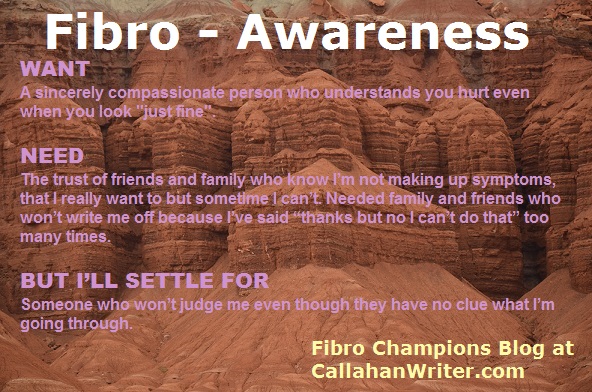
fibro_aware_want_need_settle


fibro_is_real


fibro_unpredictable


fibro_victim1


fibro_mourning


fibro-awareness1


how_fibro_affects_my_daily_life


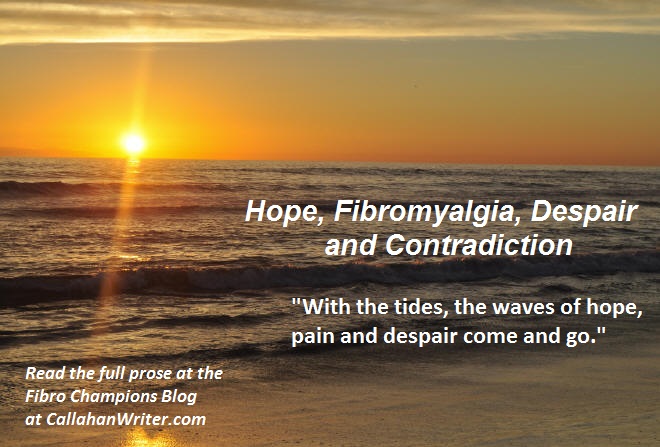
waves_of_hope_fibro_despair

Hope, Fibromyalgia, Despair and Contradiction

Hope, Fibromyalgia, Despair and Contradiction

Hope is like the waves of the ocean crashing on the beach. At first your feet get wet, and over the time, the waves get bigger, bringing in more hope, making you more wet. Eventually the waves of hope completely engulf you leaving wet with hope.

Then the waves recede back into the tumultuous ocean to leave all but your feet dry again.

waves_of_hope_fibro_despairPain is like the waves of the ocean crashing on the beach. At first your feet get wet, and over the time, the waves get bigger, bringing in more pain, making you more wet. Eventually the waves of pain completely engulf you, leaving you wet with pain.

Then the waves recede back into the chaotic ocean to leave all but your feet dry again.

Despair is like the waves of the ocean crashing on the beach. At first your feet get wet, and over the time, the waves get bigger, bringing in more despair, making you more wet. Eventually the waves of despair completely engulf you, leaving you wet with despair.

Then the waves recede back into the turbulent ocean to leave all but your feet dry again.

With the tides, the waves of hope, pain and despair come and go, engulfing you, but eventually leaving you dry and hopeless, with less pain and less despair. The contradictory waves of fibromyalgia are a fickle thing always at the beckoning of the tumultuous sea.

CallahanWriter ©

IS FIBROMYALGIA THE END OF LIFE AS WE KNOW IT? PART 3

IS FIBROMYALGIA THE END OF LIFE AS WE KNOW IT? PART 3

Three Ways To Live A Life Of Fibromyalgia With Meaning, Joy And Hope

This is the third article on coping with fibromyalgia where I have asked the question “Is fibromyalgia the end of life as we know it?” The answer is yes, your old life is over. Click on Is Fibromyalgia The End Of Life As We Know it Part One for the first article in this series  and click on Is Fibromyalgia The End Of Life As We Know It Part Two

The new life, the life with fibromyalgia can still have meaning, joy and hope. They key to this new life filled with fibromyalgia is to make adjustments and learn what is possible with an invisible chronic illness.

In the past two articles we learned the need to let go of the guilt we feel for not being able to do what we once did. We covered, letting go of the past and managing our expectations. We also discussed knowing our limitations and making allowances for what we can no longer do. This third installment is much more positive because we will dwell on improving our fibro ridden life.

Let’s look at three ways on how we can live a life of meaning, joy and hope.

1. Reinvent Yourself

For most people, the onset of fibromyalgia will turn your life into a chaotic mess dealing with all the symptoms that come with the disease. Generally, you cannot do the things you used to do before fibromyalgia became your chronic companion.

For me, I spent three or four years looking for a diagnosis and a treatment plan. Then I had to get used to it all. Even with a treatment plan, including pain management I realized I couldn’t go back to what I was doing prior to my illness. If I was going to have any sense of meaning in my life and any chance of joy or hope, I would need to reinvent myself.

It is hard to admit the life you once knew is gone for good. With the life sucking chronic pain, pulling the lifeblood out of me, I could no longer do what I used to, so making a long story short I got into writing. So now I am a blogger and a writer, which is very flexible and give my life meaning. Especially since most of what I blog about is fibromyalgia and Christian topics.

As luck would have it, I used to write in the distant past. I enjoyed it and even did some professional technical writing for a while. With my laptop, I can write while resting in my recliner. With the laptop resting on my lap, I can create an article for a blog post or I can work on my novel or create a new short story. This reinvented life is as flexible as my new life with fibro demands.

I don’t know what will work for you. That is something you will need to decide. If you’re lucky, you may still be able to do what you did before the onset of chronic pain, you may just need more flexibility.

fibro_end_of_life_part3With my reinvented self I do not have to worry about going to an office or punching a time card. I can write between naps. It gives me a purpose. I don’t know about you, but I cannot live a life without any sort of purpose and meaning.

I’ve had fibromyalgia for more than thirty years, although it wasn’t properly diagnosed for more than eleven years. I’ve had time to figure out this important step. There was a period of about four years where my time was occupied by doctor visits, sleeping, and watching TV because I couldn’t concentrate on anything else.

I still have episodes like this. But when I am up to it, I have a meaningful activity that gives me a sense of purpose. What new or modified activities can you think of that would give your life meaning and a sense of purpose. Don’t worry if the answers don’t come right away. But if you keep at it, you will figure out a purpose driven activity for the new you.

2. Manage Expectations

We touched on it previously in this series of articles, but I feel it is of such importance that it is worth touching on again and that is managing your expectations of what you can or cannot do.

I don’t know why, but there is almost always guilt associated with saying to yourself or others that you cannot do something you once found common place. Since I touched on guilt previously, I’ll just suggest this little nugget of insight about dealing with the expectations of what you can no longer do.

Instead of saying “I can no longer do that” reply by saying “while I can no longer do that, I can do this . . .” It sounds more positive and positive self talk is very important.

When your constant companion is chronic pain, fatigue and the sensations of an achy flu all over your body, sucking the life out of you, it is important to avoid guilt whenever and however you can. I am not talking about the guilt of sinning. I am talking about the unnecessary guilt we give ourselves for failure to live up to our own and others expectations of ourselves. The third thing we can do to make our new life as a fibromite better, is to manage other peoples expectations of what we can do.

Because we don’t look sick, many of the people who knew us before we had fibromyalgia will ask us do things we used to do. They will expect it of us. So what we need to do is say something along the lines of, “I’m sorry, but I can no longer do that because of fibromyalgia, but I can do this . . . .”

It is difficult to manage your own expectations of yourself when you compare yourself now to the person you once were. It is even more difficult to manage other peoples expectations of you now your new set of clothes is made from the popular new brand of fibromyalgia. I speak from decades of experience of living with chronic pain and fatigue.

3. Pacing Yourself

I swear, if I hear one more person tell me to pace myself and learn what my limits are, I think I will puke. Having said that, I want to mention it to you because it is so important. It is always a good thing to keep in mind because pacing ourselves is not something we are accustomed to doing.

Trying to pace ourselves is like placating this evil illness, we call fibromyalgia. I don’t want to pace myself because I don’t want to give into this disease. But I know, deep down, if I don’t learn to pace myself, I will not win the race between me and that f-bomb, fibromyalgia. I want to win, or at least peacefully coexist with it.

If we don’t learn to pace ourselves, then we will overdo it and, as we all know, fibromyalgia shows no mercy, it has no grace, it demands consequences to our actions however unfair that may seem. So if we want to get anywhere outside of our bed of pain, we have to pace ourselves.

We need to understand that there are things we can do if we pace ourselves and there are thing we can’t do. What we might have accomplished in a day, back before fibro set in, may take a week to do now. But if we pace ourselves, in the long run, we are better off.

Life as we once knew it, is now gone for good, or at least until modern science can develop a cure or a better treatment plan. However, at least for me, these three items previously mentioned help to cope with fibro much better and allow me some sense of normalcy. They give me a sense of meaning, joy and hope for the future.

There will be at least one more article in this series and maybe two so click on the follow button so you’ll know when those posts arrive.

Troy Wagstaff ©

This is written for informational purposes only and not for medical advice. I assume no liability for the application of this information. Please see your health care provider for any medical advice.

14 Ingredients For Fibro Stew – The Recipe for Fibromyalgia Stew

Fibro Stew

The Recipe for Fibromyalgia Stew

fibro_stewIt has long since become a common practice to share recipes online via Facebook, Pinterest and other social media sites. I would like to share with all of you the recipe for fibromyalgia stew. The problem with the recipe for fibro stew is, no one knows what causes fibromyalgia. Researchers do know what the ingredients to fibro stew are. But they don’t know how to mix them, cook them or how high the temperature should be.

But knowing the ingredients of fibromyalgia stew will at least give you a good idea what it tastes like.

1. Chronic Pain

The primary ingredient to fibro stew is wide spread chronic muscle and tissue pain. The element of chronic pain can be as simple as carpel tunnel pain in your wrist to sciatica nerve pain in your lower back and legs. This chronic pain ingredient can pierce deep into the core of your spine and it can cause all kinds of muscle spasms. Chronic pain is the chief additive to fibro stew.

2. Chronic Fatigue

A liberal dose of chronic fatigue added to the stew is very important. This type of chronic fatigue is not the Swiss, French or Mexican type of fatigue, it’s the type of chronic fatigue you feel when you wake up after a good nights rest feeling unrefreshed and worn out. It’s the type of fatigue you feel when you are recuperating from major surgery and your body craves sleep and rest to heal. You can nap and sleep all day long and still feel tired and void of energy.

fibro_stew

3. Fibro Fog

This common part of the recipe, fibro fog, is when you know what words to use, you even know the meaning of the word, but can’t think of the actual word. It’s going into another room to look for your reading glasses only to find them on your head or looking for the car keys while they are in your hand. The ingredient of fibro fog is where you know the answers, it just takes a longer time than usual to get them. With fibro fog you forget what you were concentrating on.

4. IBS

By glancing over this list of ingredients of fibro stew you can clearly see there are a lot of elements to the stew, Irritable bowl syndrome is just one of many elements to the stew. IBS is also served as entree for some people that don’t have fibro stew.

5. Tension Headaches

Don’t confuse chronic fibro pain with tension headaches. While they share a common element, which is pain, they are still different ingredients. When your muscle spasms get so tight they cause your head to ache, then you know you have the right ingredient in fibro stew.

6. Migraines

Migraine headaches are another big part of fibro stew. It has similarities with chronic pain and tension headaches, which is, terrible pain, but it is a separate ingredient to the stew and a unique part of the stew.

7. Depression

Depression is a key element to the mix. Several of these ingredients can be served as an entree or be part of the fibro stew. Depression is just one of the many of elements of fibro stew. It is often served as its own entree.

8. Tremors

Tremors in the extremities are a common additive to the Fibro stew. Sometimes your hands, legs or feet can have such violent tremors that you might loose the food from your fork or spoon. This item can be optional as it is not something that every fibro stew has.

9. Insomnia

It can seem strange that elements of the stew can be as diverse and yet related as chronic fatigue and insomnia, but this list of ingredients can appear to be contradictory at times and that is the nature of this recipe. Don’t question the chronic contradictions in these ingredients, but rather embrace them.

10. Sensitivities

Sensitivities like a sensitivity to sunlight or UV rays are a common element in the recipe of fibro stew along with other categories of sensitivities like noise and chemical sensitivities. Like herbs and various seasonings, the sensitivities can vary according to taste and circumstances.

11. High Sensitivity To Stress

Any chef or health care provider knows that stress, through no fault of your own, is a major component to many medical conditions like high blood pressure, migraines, and fibromyalgia. Use the sensitivity, ingredients according to how your stew works.

12.  Night Sweats

Night sweats are also an optional ingredient, however, it is more common than you might think for a good recipe of fibro stew.

13. Coordination Issues

Some people thing that the coordination issue ingredients are related to other parts of the stew, but it is a surprisingly popular element to the stew.

fibro_awareness_subart

14. Anxiety

Anxiety is another often overlooked, but a big part of fibro stew. It’s not for everyone, but it is a part of a fibro stew of many people. Use accordingly.

There are even more parts to a typical fibro stew. We have only scratched the surface of what goes into the fibromyalgia recipe. There are many factors and other parts to consider when listing all that goes into chronic fibro stew.

As we said at the beginning, we don’t know how long to cook this recipe or at what temperature or in what proportions, but knowing what goes into fibro stew can give you an approximate idea of the fibro stew flavor.

Just as fibro stew is real so are the ingredients. This fibro stew mentions fourteen ingredients. There are more than seventy symptoms. Add to the main ingredients the other ingredients (symptoms) according to what you suffer from and viola, you have a tasty painful fibro stew.

Do you have any other ingredients that are a part of to your fibro stew that you would like to share with us? I’ love to hear them.

Troy Wagstaff ©

This is for informational and entertainment purposes only. This is not medical advise. Consult your health care provider for medical advise.

RIP – 9 Things I Miss About My Old Fibro Free Life

RIP – Mourning The Loss Of Your Pre-Fibro Life

I lost a dear friend. It’s been eleven years now, but I still miss him. He was married with three girls. He enjoyed being active with his wife and children. He would take them swimming and fishing. They played in the snow together.

He was very active. He liked to run and ski. He was an avid gardener. He enjoyed skeet shooting and target shooting. He was a hard worker. He started his own business and worked 18 hours a day to get it up and running. It was quite successful until near the end.

His life was taken from him, at least the life he knew was taken from him by fibromyalgia. It’s been eleven years now and his life will never again be the same. He is still a fond memory, but I miss him every day. But now I live and battle and strive to exist and to be meaningful in spite of fibromyalgia. I still have hope for a new life with fibromyalgia.

Nine specific things my old self didn’t have to worry about, which is nine things I miss about my old fibro free life.

rip_hope1. No chronic pain

2. Appropriate energy

3. Sufficient strength

4. Ability to be spontaneous

5. Ability to work

6. Lack of sleep problems

7. The ability to remember everything I normally could

8. Participate in hobbies the fibro took away.

9. Participate in everything else the fibro took away.

But until I get back to my old self, yes, I hold out hope that I will be fibro free and back to my old self, either in this life or in the next life, I will be fibro free.